

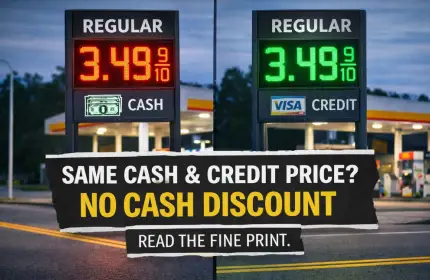
 I’m in the tri-state area, running on fumes, and I pull into a station that looks “cheap.” The sign shows one price. The pump shows one price. No big “cash” or “credit” split.
So I do what most people do: I pay and move on.
But here’s the part most drivers miss:
When cash and credit are the same price, what that usually means is there’s no cash discount. You’re paying the credit price either way.
Why stations do this (it’s not magic — it’s fees)
Gas stations pay credit-card processing (“swipe”) fees. According to the convenience-store industry’s trade association (NACS), those card costs can add up to about 7.5 cents per gallon for credit (and about 2.4 cents per gallon for debit), on average. (Convenience)
So a station typically has a few ways to handle it:
- One posted price for everyone(the card cost is baked into that price)
- Two prices(a cash discount and a higher credit price)
- A surcharge/fee model(rules vary by location, and disclosure matters)
That’s why when you don’t see a cash/credit split, it’s reasonable to assume the posted price already reflects the cost of taking cards. Consumer Reports has covered this exact dynamic: stations use cash discounts largely because card acceptance costs them money. (Consumer Reports)
The 5-second test: are you actually getting a cash discount?
If a station truly offers a cash discount, it usually shows up in one of these obvious ways:
- Two prices on the street sign(cash and credit)
- A clear label at the pump: “Cash price / Credit price”
- A posted notice that paying cash gets a lower price
If none of that exists and it’s one clean number everywhere, then, functionally, there’s no discount to collect.
Why this matters more in the tri-state area
In New York, consumer-protection rules emphasize clarity if a credit purchase costs more: guidance explains that businesses charging more for credit must display the highest total price to customers. (NYC311)
Translation for drivers: you shouldn’t have to discover the “real” price after you’ve already committed to the pump.
That doesn’t mean every station is trying to trick you. It does mean you should read the pricing the same way you read a contract: assume the important part is either clearly posted… or quietly not offered.
The consumer takeaway
If you’re paying cash because you believe it’s cheaper, make sure the station is actually offering you something for it. If cash and credit are the same, cash isn’t a “hack”—it’s just cash.
And here’s the bigger point:
When a station posts one price and calls it “cash or credit,” it’s not a deal — it’s a decision they made for you.
And if they’re willing to blur the line on something as basic as a cash discount, it’s fair to ask what else is being handled the same way — quietly, in the fine print, or in ways you won’t notice until it costs you.
If they won’t be transparent about the price you can see, imagine how they handle the things you can’t.
Read the sign. Read the small print. And don’t confuse “cheap” with “honest.”