

I can handle a lot. Winter. Potholes. Toll booths. Even that one guy who camps in the left lane like it’s a long-term rental.
But the thing that gets me every year?
Prices start creeping up right when I’m finally ready to get out of winter. And if you’re in the tri-state area, you’ve seen it: one week the sign looks reasonable, the next week you’re squinting at it like it personally betrayed you.
So what’s driving fuel prices higher right now?
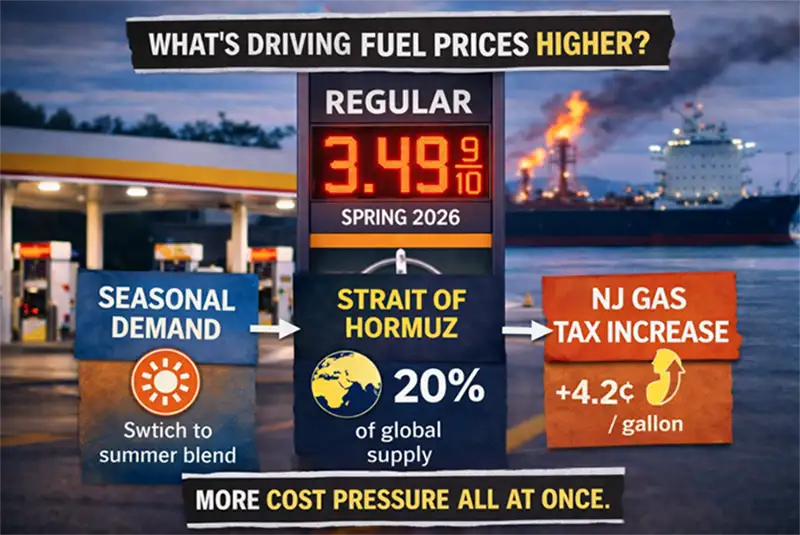
It’s usually not one thing. It’s a combo punch — and at the moment it’s two punches at the same time:
- Seasonal spring pressure
- Global conflict risk that pushes crude and diesel higher
And in New Jersey, there’s a third layer baked in for 2026.
Head #1: The Spring Switch (yes, it’s a real thing)
Even when crude oil isn’t doing anything dramatic, gasoline prices can still rise because spring brings two realities:
- People start driving more as winter fades
- The industry moves through seasonal transitions that can tighten supply
EIA explains that retail gasoline prices tend to rise in the spring and peak in late summer as people drive more, and that gasoline specifications/formulations change seasonally (including summer blends). (U.S. Energy Information Administration)
NACS (the convenience and fuel retail trade group) describes this seasonal pattern, noting prices have historically climbed from early February into mid-May during the spring transition. (Convenience)
Translation: even in a “normal” year, spring can lift prices.
The NJ layer: 2026 fuel tax increase (local pain is real)
In New Jersey, there’s also a built-in reason prices can feel “extra” this year: the state’s Petroleum Products Gross Receipts Tax increased on January 1, 2026.
New Jersey Treasury announced the rate change:
- Gasoline PPGRT: 34.4¢ → 38.6¢ per gallon
- Diesel PPGRT: 38.4¢ → 42.6¢ per gallon
With the fixed Motor Fuels Tax included, Treasury stated the total state tax at the pump becomes:
- 49.1¢/gal gasoline
- 56.1¢/gal diesel (NJ.gov)
That doesn’t explain every spike — but it raises the baseline underneath everything else.
Head #2: Conflict risk — and why it hits your pump fast
Now layer on global risk.
When markets believe oil flows could be disrupted (or shipping lanes become dangerous), crude prices often build in a “risk premium,” and the price chain reacts quickly.
A big reason is the Strait of Hormuz — and you don’t need a deep dive to understand why it matters:
In 2024, EIA reported that oil flows through the Strait averaged about 20 million barrels per day, roughly 20% of global petroleum liquids consumption. (U.S. Energy Information Administration)
So when headlines center on Hormuz risk, prices can jump even before any long-term shortage shows up — because the world treats that waterway like a critical valve.
Why you feel it at the pump even if “crude isn’t that high”
Here’s the part most people don’t connect:
Pump prices aren’t only about crude. If gasoline supply tightens (from seasonal changes, refinery constraints, or distribution issues), retail can move fast.
EIA notes prices can change rapidly when something disrupts crude supply, refinery operations, or product delivery — and also emphasizes the seasonal demand/spec effects. (U.S. Energy Information Administration)
So you can have a situation where crude isn’t exploding, but finished product markets get tight — and the sign price responds.
The takeaway: it’s not one thing — it’s stacked pressure
If prices are rising right now, it’s typically:
- Spring demand + seasonal fuel changes that tighten supply (U.S. Energy Information Administration)
PLUS
- Global conflict risk that pushes crude and distillates higher (and makes shipping lanes matter a lot) (U.S. Energy Information Administration)
PLUS (in NJ)
- A higher 2026 tax baseline that makes every move feel worse at the pump (NJ.gov)
That’s the two-headed monster — with a Jersey weight vest.
Ross Enterprises (Ross Fogg): Compliant, Reliant & Mission Ready.