

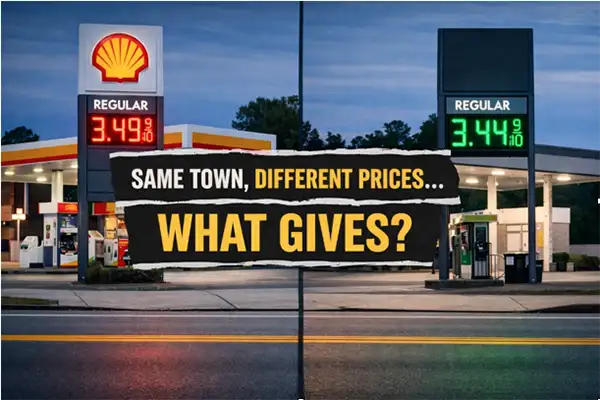
There are two gas stations in my town sitting across from each other, and I do what I always do: I pull into the cheaper one.
Because it feels like the smart move. Same gasoline, right? A few cents cheaper per gallon, and I’m out.
But while I’m standing there watching the numbers climb, I catch myself thinking: “If all gas is the same… why isn’t everyone going to the cheap station?”
That question stuck with me.
I couldn’t let it go. I did some digging—because there’s always a reason. And it turns out the price on the sign is the end of a long chain.
The “price on the sign” is the end of a long chain
What you pay at the pump isn’t one number. It’s the end result of a bunch of moving parts—crude oil costs, refining, distribution/marketing, and taxes—plus whatever margin the station decides it needs that day.
And the biggest thing most people don’t realize is this:
Not every station pays the same wholesale cost for fuel.
The wholesale part most people never see: “rack” pricing and OPIS
A lot of fuel gets bought and sold off wholesale benchmarks, and OPIS is one of the major sources used in the industry to track and reference those wholesale market prices.
The “rack” is basically the wholesale terminal level—where fuel leaves the refinery/pipeline system and gets picked up for distribution.
So when fuel is priced using an OPIS benchmark, it’s essentially referencing a third-party “scoreboard” for what wholesale fuel costs in that market at a given time.
So why would two stations across the street be different?
Here are the most common reasons—simple and real:
- They bought at different times. One station might be selling fuel delivered when wholesale prices were higher. The other might have just taken a delivery after wholesale eased.
- They’re not buying from the same place.“Same town” doesn’t mean “same supply chain.” Different suppliers can lift from different terminals or run different pricing programs, and that changes cost.
- Branded vs. unbranded (this matters more than people think).
Branded fuel (the major brands) typically includes detergent/additive packages designed to help keep engines cleaner over time.Unbranded fuel can still meet basic requirements—but it generally doesn’t come with the same detergent package.
The easiest way to think about it is this:
Unbranded gas is like processed food vs Whole Foods.
It’s cheaper and it fills you up… but over the long run, it may not be doing you any favors. - Cash vs. credit economics.
Card processing costs money. Some stations build that into the sign price; others offer a cash/credit split.
And here’s the part people miss: when cash and credit are the same price, what that really means is: there’s no cash discount. You’re paying the “credit” price either way. - Different strategy.
One station might intentionally price fuel low to drive inside-store sales. Another protects margin at the pump. - Different overhead.
Rent, labor, utilities, maintenance—those costs vary site to site, and the pump price reflects it.
Now the part nobody likes hearing: maybe the cheaper station isn’t “better”
Here’s where I had to check myself.
I’m obsessing over nickels… and I’m not even buying that much at a time.
So let’s say I’m buying 10 gallons and the station across the street is $0.05 cheaper.
That’s 50 cents.
And now the real question hits me: Is that 50 cents worth it if the other station’s fuel is branded and designed to help keep an engine cleaner over time?Because if that tiny difference buys me even a little peace of mind—cleaner performance over time, fewer deposits building up, fewer headaches later—it’s hard not to think it’s a trade worth making. Or… would I rather have the 50 cents right now?
What does 50 cents even get me anymore?
Ross Enterprises (Ross Fogg): Compliant, Reliant & Mission Ready.